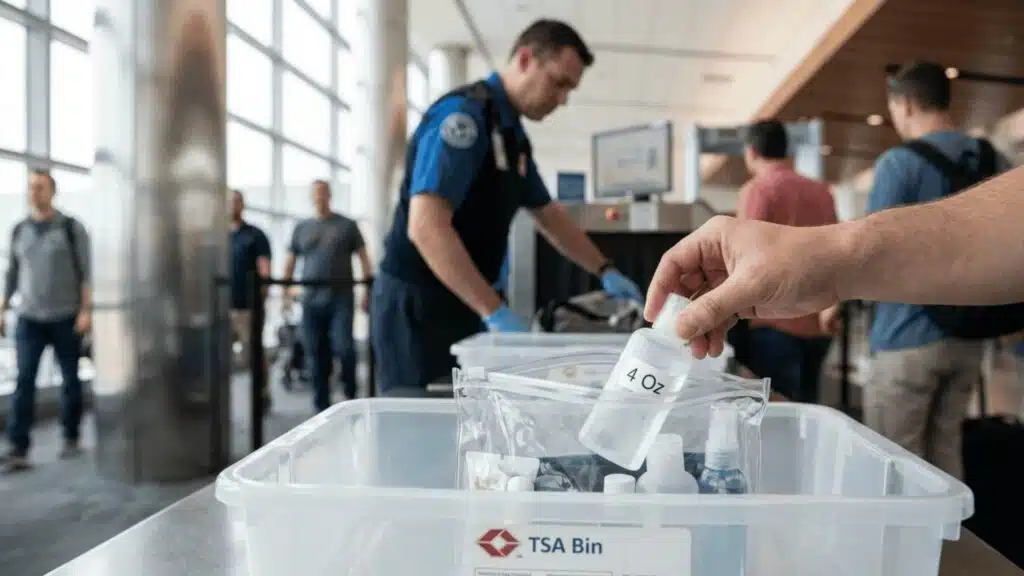
Airport security has a way of turning a small oversight into a stressful, hold-up-the-line moment.
A 4-oz bottle sitting in a carry-on is one of the most common ones and one of the most misunderstood.
Many travelers assume a 0.6 oz difference won’t register, or that a half-empty bottle gets a pass. It doesn’t.
This guide explains what happens when a 4-oz bottle goes through TSA screening and why the rule works the way it does.
It also covers your real options, including a few that most travelers don’t know about
Understanding The TSA 3-1-1 Liquid Rule
TSA follows a strict system for liquids in carry-on bags. The 3-1-1 rule keeps things consistent and easy to check.
Each passenger can carry liquids in containers no larger than 3.4 ounces (100 milliliters). All containers must fit inside one clear, quart-sized bag. Only one bag per traveler is allowed.
The key detail is the container size, not the amount of liquid inside. Even a half-full 4-oz bottle still breaks the rule; TSA officers check the label, not the fill line.
As a TSA uniformed advisor confirmed to Reader’s Digest, a larger bottle, such as one that holds 4 ounces, cannot pass through even if it contains only 3.4 ounces of liquid.
Will TSA Notice a 4 oz Bottle?
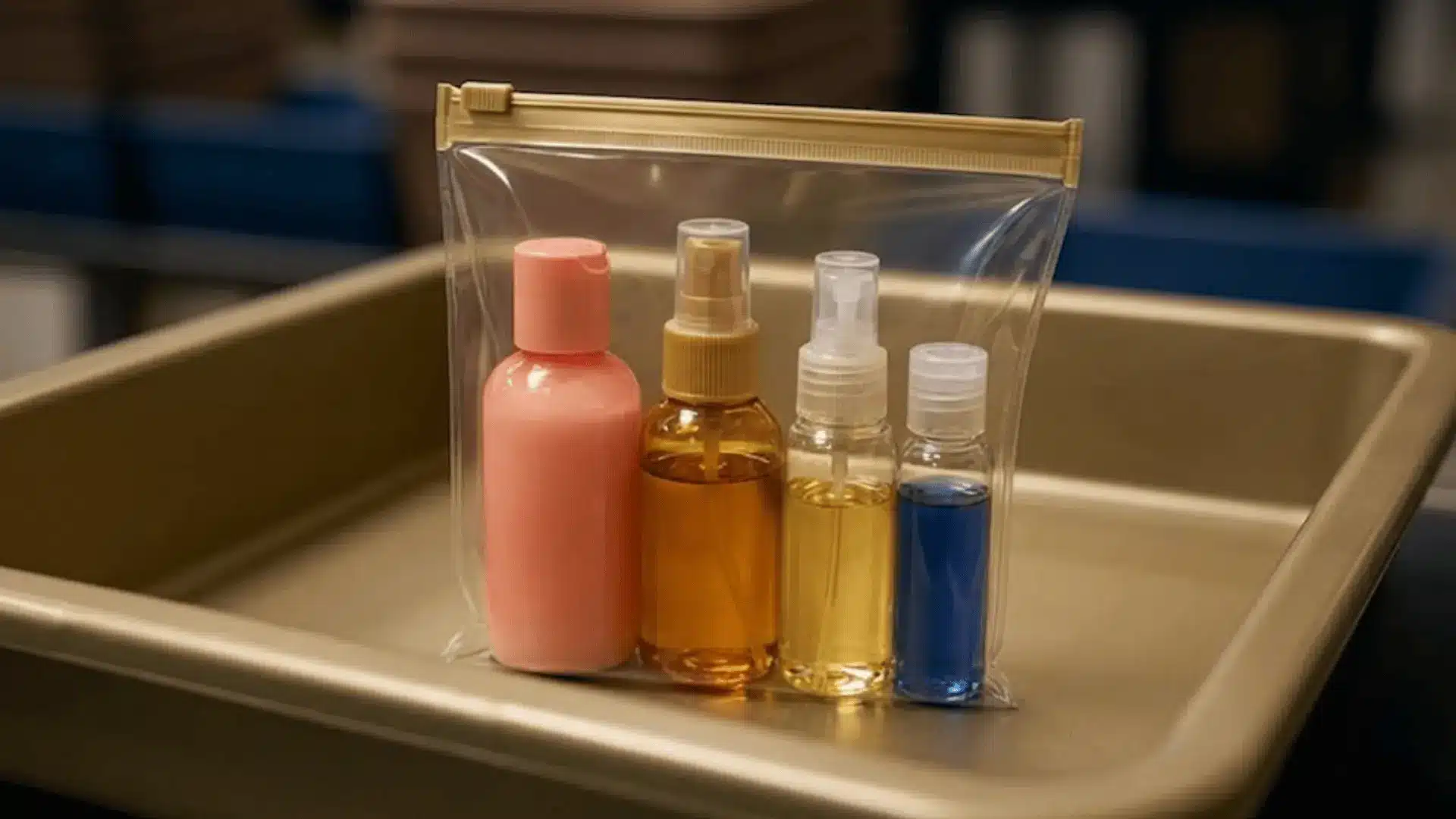
Yes, TSA will notice a 4-oz bottle in most cases. Screening technology and manual checks are designed to quickly catch size violations.
Carry-on bags pass through X-ray machines that clearly highlight liquid containers. Officers are trained to identify anything that exceeds the allowed limit.
Even if the difference seems small, a 4-oz label stands out on the screen. The decision is not based on judgment or guesswork; it is based on the visible container size.
What Happens if You Bring a 4-oz Bottle Through TSA
Bringing a 4-oz bottle does not mean serious trouble, but it will slow things down, and you will most likely lose the item.
If detected, a TSA officer will remove the item during screening and may ask you to step aside.
At that point, you typically have one of two choices: surrender the bottle or step out of the security line and transfer it to a checked bag if you have one.
Most travelers don’t realize the second option exists. If you’re running close on time, surrendering it is the faster call.
There are no fines or penalties for first-time mistakes.
But losing a $30 face serum or a perfume you forgot to check is frustrating enough to be worth a two-minute bag check before leaving for the airport.
Why TSA Focuses on Container Size, Not Liquid Amount
Many travelers assume that carrying less liquid inside a larger bottle is acceptable. That is not how TSA rules work.
Security checks rely on standardized limits that are easy to verify at scale.
Measuring actual liquid volume inside each container would grind the entire process to a halt. Imagine that negotiation happening at every checkpoint, hundreds of times a day.
A labeled 4-oz bottle automatically exceeds the approved limit, regardless of its level.
The rule has been in place since 2006, introduced after authorities uncovered a plot involving liquid explosives.
That origin matters; it explains why TSA treats the container as the threat unit rather than the contents.
What Counts as a “Liquid” Under TSA Rules
This is where many travelers get caught off guard. TSA defines “liquid” broadly: if it can pour, spread, spray, or smear, it is treated as a liquid at the checkpoint.
That includes toothpaste, mascara, nail polish, perfume, peanut butter, and even lip gloss.
Solid deodorant does not count, but spray deodorant does.
If you travel with a product that sits in a gray area, the safe assumption is that it falls under the 3-1-1 rule.
For a deeper look at whether your deodorant counts, a clear breakdown of deodorant and TSA rules covers it in full.
Common Situations Where Travelers Get Stopped
Most confiscations aren’t from people trying to sneak something through; they’re from people who genuinely forget to check. A few of the most common scenarios:
Grabbing a familiar product on autopilot without checking the label. Sunscreen, dry shampoo, and setting sprays are frequent offenders because the full-size versions are so standard.
Assuming that being slightly over the limit is fine because it’s “never mattered before.”
That inconsistency is real; enforcement can vary by airport and officer, but it’s not something to count on.
Repacking a toiletry bag that was last used for a checked-bag trip, where size didn’t matter.
Tips to Avoid Issues with TSA Liquid Rules
- Check bottle labels before packing and stick to 3.4 oz or smaller
- Transfer products into travel-size containers when needed, especially serums, perfumes, and hair oils that come in larger bottles by default
- Use a quart-sized bag and keep it accessible since 2024; it doesn’t technically need to be clear, but a transparent bag still speeds up the process
- Double-check carry-on items before leaving for the airport
- Place liquids separately during screening for faster checks
- Bring an empty reusable bottle through security and fill it at a water station post-checkpoint — saves money and keeps you hydrated without any size headaches
Exceptions to TSA Liquid Rules you Should Know
A few categories are treated differently and are allowed to exceed the 3.4 oz limit in carry-on bags, provided they are declared to a TSA officer at the checkpoint:
- >Medications: Prescription liquids, insulin, saline solution, and other medically necessary items are permitted in reasonable quantities. Keep them in their original, labeled bottles, where possible, to speed up the screening process. Many checkpoints now use Bottle Liquid Scanners (BLS) to verify these without opening containers.
- Baby formula and breast milk: These can be carried in quantities beyond 3.4 oz. They will be screened separately but will not be confiscated.
- Duty-free purchases: Liquids bought at an international duty-free shop and packed in a sealed, tamper-evident bag (STEB) can be carried through security in larger quantities, provided the seal is intact, and you have the receipt from within the past 48 hours.
Frozen liquids are also worth knowing about if a liquid is fully frozen solid at the time of screening, TSA treats it as a solid, not a liquid. Timing that is tricky, but it is a real exception.
What About the Future of the Liquid Rule?
The 3-1-1 rule is still fully in effect in the U.S. as of 2026, but change is coming slowly.
The TSA is gradually installing CT (computed tomography) scanners at select airports.
This is the same technology that has already led several major UK airports, including Heathrow and Gatwick, to raise their liquid limits for departing passengers
Until CT scanners are standard across U.S. airports, the 3.4 oz rule remains the default.
Pack assuming it applies and check your departure airport’s specific setup if you’re flying internationally, since the rules on the return leg may differ.
Conclusion
A 4-oz bottle may seem like a minor detail, but the TSA’s 3-1-1 rule has no flexibility on container size, and a 0.6-oz difference is enough to get a product confiscated.
The good news is that this is entirely avoidable with a quick check before you pack.
Transfer products you love into travel-size containers, use checked luggage for full-size items, and know the exceptions for medications, baby formula, and duty-free STEBs before you fly.
A few minutes of preparation is genuinely the difference between breezing through security and watching your favorite moisturizer land in a bin.
If you’re building out a travel beauty routine and want to know which treatments hold up long-term without constant re-packing headaches, semi-permanent options are worth considering.
Still unsure what you can pack in your carry-on? Drop your questions in the comments, and share what you plan to bring.