Have you ever wondered why grandmothers across India still keep a jar of amla oil on the bathroom shelf? This small, sour fruit, also called Indian gooseberry, has been rubbed into scalps for generations, long before the phrase “hair care routine” existed.
The amla oil benefits for hair that keep it popular today include stronger strands, less dryness, a calmer scalp, and shine that skips silicone.
It will not fix every hair problem on its own, and this piece stays honest about what it does and what it doesn’t. Below, see what amla oil does, how research backs it up, how to apply it without weighing hair down, and how it compares to coconut and rosemary oil.
What is Amla Oil, Exactly?
Amla oil is made by infusing dried or fresh Indian gooseberry (Phyllanthus emblica) into a carrier oil, most often sesame or coconut oil, sometimes through slow heating and sometimes through cold infusion.
The fruit itself is one of the richest natural sources of vitamin C, along with polyphenols and tannins that give it its sharp, sour taste. Because the fruit is water-soluble, the oil version carries only part of what the raw fruit offers.
Cold-pressed or fresh amla juice tends to hold more of the vitamin C than the infused oil sitting on a shelf for months, which is worth knowing before you expect the oil to work exactly like the fruit does.
Amla has been used in Ayurvedic medicine for over a thousand years, not just for hair but for digestion and immunity too.
That long history helps explain why it earned a place in modern hair care aisles, but tradition alone isn’t proof. The next sections separate what is well supported from what is still more folklore than fact.
Amla Oil Benefits for Hair Health

Amla oil is a traditional hair care ingredient valued for its nourishing properties and its potential to support stronger, smoother, and healthier-looking hair while addressing common concerns like breakage, dryness, and dullness.
1. Supports Healthier Hair Growth
Amla oil may support conditions that favor hair growth, mainly by keeping the scalp nourished and reducing the small breakages that make hair look like it has stopped growing.
It does not grow new follicles, and no oil can. What it can do is protect the length you already have, so fewer split ends and snapped strands mean your hair reaches its natural length instead of breaking off early. Think of it less as a growth serum and more as damage control that lets growth show.
2. Helps With Hair Fall From Breakage
The conditioning fatty acids in amla oil coat the hair shaft, reducing the friction that causes strands to snap during brushing or sleep. This matters because much of what people call “hair fall” is actually mid-strand breakage, not shedding from the root.
For hair fall caused by genetics, thyroid issues, postpartum shifts, or iron deficiency, amla oil will not be enough on its own, and a dermatologist visit is the better next step.
3. Improves Hair Strength and Thickness
Regular use smooths the outer cuticle layer, so each strand catches less on its neighbors and feels less rough between your fingers.
This shows up most on second-day hair, where the usual frizz and static settle down after a week or two of consistent use. The number of hairs on your head stays the same, but smoother, less broken strands read as thicker and fuller when you look in the mirror.
4. Adds Shine Without Heavy Buildup
Dull hair usually comes from a rough cuticle scattering light instead of reflecting it. Amla oil’s fatty acid content lies flat on the hair surface, which helps light bounce off in one direction instead of many, and that is what reads as shine.
Used in small amounts, it does this without the waxy buildup that heavier oils like castor can leave behind.
Across all of these areas, the honest summary is that amla oil supports and protects rather than transforms. Results depend heavily on hair type, scalp condition, and how consistently you use it.
How to Use Amla Oil without Weighing Hair Down
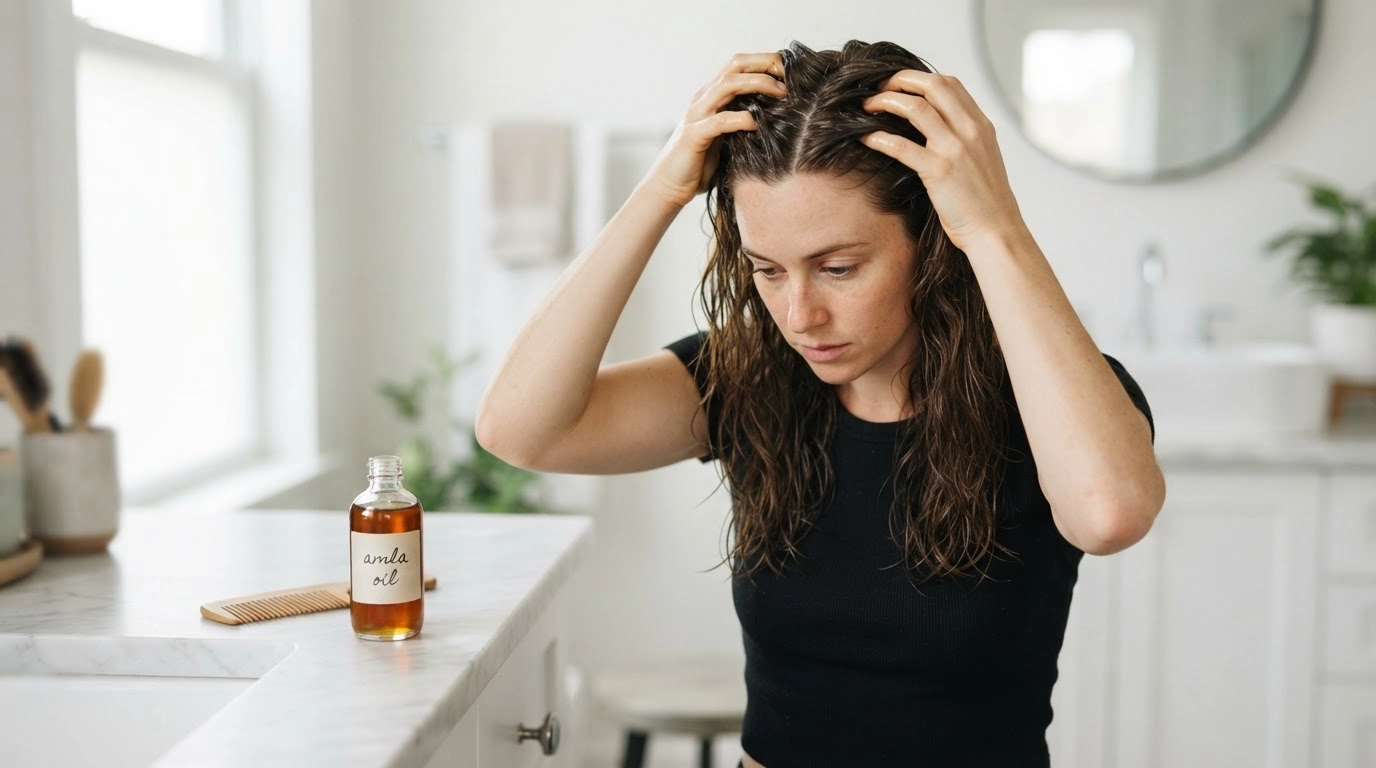
Using amla oil in the right way helps maintain its conditioning benefits while keeping hair soft and manageable. A simple routine based on hair type, scalp condition, and application method can improve results.
- Warm it slightly first: Rub it between your palms for a few seconds, or dip the bottle in warm water, to help the oil spread evenly and absorb faster.
- Massage it into the scalp, not just the ends: Use small circular motions with your fingertips for two to three minutes to boost blood flow to the follicles.
- Match the amount to your hair: A coin-sized amount works for fine or shoulder-length hair. Thick or long hair may need two to three times that.
- Leave it on for one to two hours, not always overnight: Overnight application can work well for very dry hair, but oily scalps usually do better with a shorter sit time to avoid buildup by morning.
- Wash it out properly: One shampoo wash is rarely enough to remove oil completely. Plan on two washes, focusing the second one on the scalp.
Amla oil works best when added consistently to a balanced hair care routine. Using the right amount and frequency can help keep strands smoother, softer, and healthier-looking.
Amla Oil for Different Hair Concerns
Amla oil may suit different hair needs depending on texture, scalp condition, and common concerns. The table below highlights how it may help while keeping expectations realistic.
Hair Concern | How Amla Oil May Help | Realistic Expectation |
Dry, damaged hair | Adds moisture and smooths rough, lifted cuticles | Improves texture but will not undo heat or chemical damage that has already happened |
Oily scalp | Light application nourishes without heavy residue | Works best in small amounts, applied for one hour rather than overnight |
Curly or textured hair | Helps retain moisture and reduces frizz along the shaft | Improves manageability but will not loosen or change the curl pattern itself |
Premature graying | Traditional use pairs it with antioxidant support for the scalp | There is no reliable evidence it reverses gray hair caused by aging or genetics |
Thinning edges or fine hair | Lightweight formulas nourish without adding visible weight | Use sparingly, since too much oil can make fine hair look flatter, not fuller |
Note: Amla oil works differently for each person depending on hair type, scalp condition, and the rest of the routine around it. Treat these as starting points, not guarantees.
A balanced approach helps you use amla oil effectively while keeping expectations realistic. It can support healthier-looking hair when combined with consistent care habits.
What the Research Actually Says About Amla Oil for Hair Growth
Amla has centuries of use in Ayurveda, but clinical research on the oil form specifically stays thin. Most studies look at amla fruit extract or powder taken internally or as a paste, not the pressed oil sold in bottles today.
Its antioxidant compounds, including vitamin C, are well documented for protecting cells from oxidative stress. The leap from amla having antioxidants to amla oil for hair growth working faster has not been proven in controlled human trials.
The U.S. National Center for Complementary and Integrative Health notes many traditional plant-based remedies need more rigorous study before their effects can be confirmed.
Hair fall has many causes, and no single oil addresses all of them. The honest claim is that amla oil supports a healthy scalp and reduces breakage-related hair fall, not that it regrows hair or stops shedding.
Amla Oil Side Effects and How to Patch Test It
Amla oil is gentle for most people, but “natural” does not mean “risk free.” A small number of people react to it, usually because of an added fragrance or a preservative in a commercial blend rather than the amla itself.
- Patch test 24 hours before using it on your scalp: I don’t skip this step for a client, and I don’t skip it for myself either. Apply a small amount to the inside of your wrist or behind your ear and wait a full day before putting it on your scalp.
- Watch for redness, itching, or small bumps: These usually point to a fragrance or preservative sensitivity, not the amla fruit itself.
- Skip it on broken or inflamed skin: Open scratches, active dandruff flares, or a recently colored scalp with irritation are not the time to introduce a new oil.
- Check the ingredient list, not just the front label: Look for amla near the top of the list and avoid products padded mostly with mineral oil or synthetic fragrance.
- See a dermatologist for anything that does not clear up in a few days: Persistent redness or itching after you stop using it is worth a professional look rather than switching to yet another product.
Using amla oil carefully and choosing the right application method can help support a comfortable hair care routine while minimizing possible reactions.
Amla Oil vs Other Hair Oils
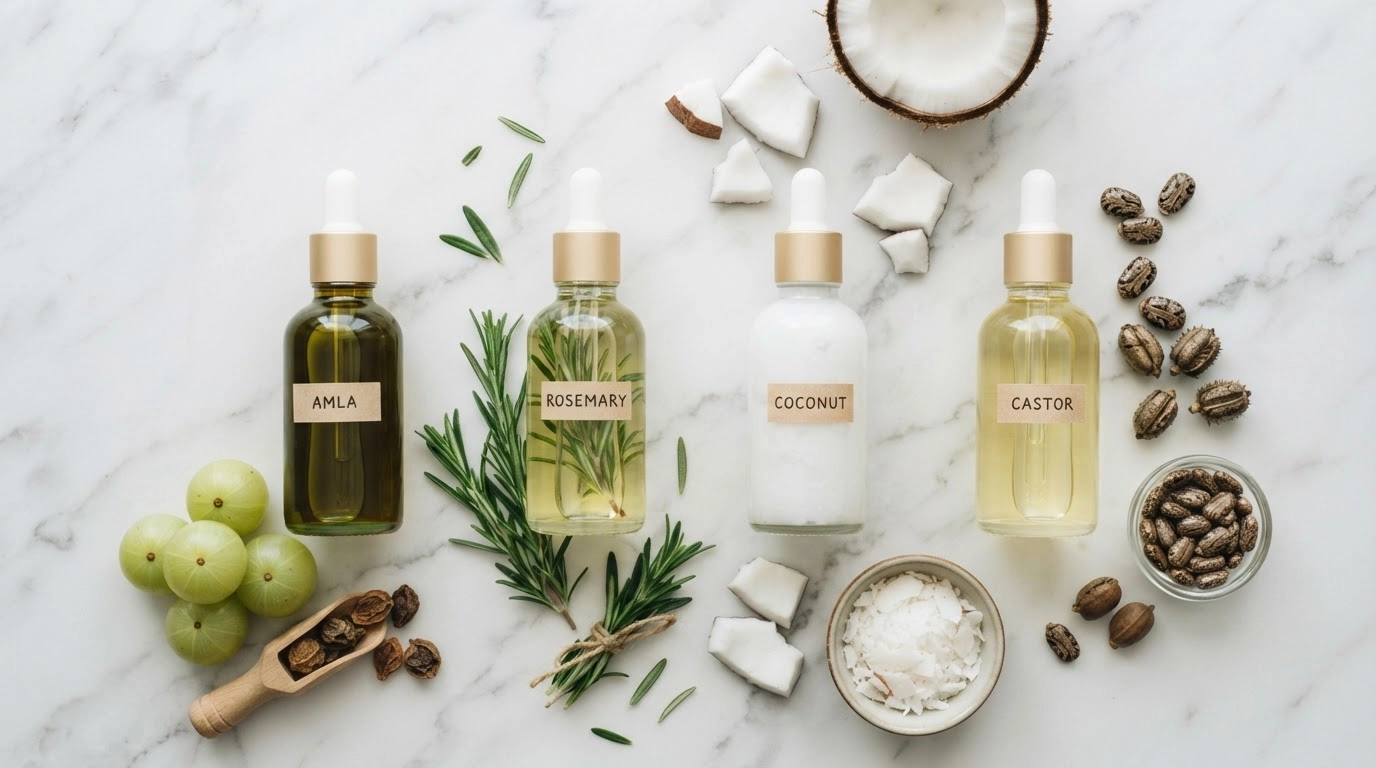
Different hair oils offer different benefits depending on hair needs and concerns. Comparing their key properties can help you choose an option that matches your routine, whether you want nourishment, moisture, scalp care, or improved hair texture.
Oil | Best Known For | Texture on Hair |
|---|---|---|
Amla oil | Scalp nourishment, shine, and reducing breakage-related hair fall | Light to medium, absorbs quickly |
Coconut oil | Deep moisture for very dry or porous strands | Heavier, can weigh down fine hair |
Rosemary oil | Scalp circulation, usually used diluted in a carrier oil | Very light, rarely used alone |
Castor oil | Sealing in moisture and thickening the look of brows and lashes | Thick and sticky, needs thorough washing out |
Amla oil for hair fall works well alongside these other oils, not instead of them. A common combination is amla oil on the scalp with a lighter coconut or argan oil sealed over the ends for extra moisture.
How to Choose a Good Amla Oil
- Check where amla sits on the ingredient list. If it is buried after five other oils and a long list of fragrance chemicals, you are mostly paying for filler.
- Cold-pressed or slow-infused is preferable to heavily processed. High-heat processing can degrade some of the antioxidant content.
- Avoid added mineral oil as a main carrier if you have fine hair. It tends to sit on the surface rather than absorb, which leaves hair looking flat.
- Smaller bottles are often smarter than bulk buys. Natural oils can turn rancid within six to twelve months once opened, especially if stored somewhere warm.
- The priciest bottle isn’t automatically the best. A mid-range, honestly labeled oil does the job for most people, and I would rather someone spend on consistency than on a fancier label.
Final Thoughts
The amla oil benefits for hair that actually hold up are simple: a smoother cuticle, less breakage-related hair fall, and a natural shine that does not need extra product on top.
It will not fix every hair concern, and I would rather you expect a steady, small improvement than a miracle in a bottle. Patch testing first and using it consistently as part of a wider routine is what actually gets results.
Give it a full hair cycle before judging whether it works for you, not just a week. Have you used amla oil before? Share what worked, or did not, in the comments below.
Frequently Asked Questions
Can I Mix Amla Oil with Other Hair Oils Like Coconut or Argan?
Yes. A light layer of amla oil on the scalp followed by coconut or argan oil on the ends is a common combination, since amla is thinner and absorbs faster while the heavier oils seal in moisture along the length.
Does Amla Oil Work on Color-Treated or Chemically Straightened Hair?
It can help with the dryness color and chemical treatments often cause, but it will not restore hair already structurally damaged by bleach or relaxers. Pair it with a bond-building treatment for chemically processed hair.
How Long Before I Actually Notice a Difference?
Shine and softness are usually the first changes, often within one to two weeks. Reduced breakage takes longer to show, generally four to eight weeks, since it depends on new growth replacing already damaged strands.
Can Men Use Amla Oil, or Is It Mainly for Longer Hair?
Amla oil works the same way regardless of hair length or gender. It is just as useful for scalp health and reducing breakage on short hair, though the amount needed will be smaller.
How Should Amla Oil Be Stored so It Does Not Go Bad?
Keep it in a cool, dark spot away from direct sunlight and heat, and check for a change in smell before each use. Most opened bottles stay good for six to twelve months, less if the oil was cold-pressed without preservatives.