That tiny brown spot can make anyone pause. Is it just sun pigment, or something that needs closer attention?
Freckles and moles can look similar at first glance, but they do not form the same way or behave the same over time.
As someone who has spent years helping clients track changes on their skin, I always start with simple clues: color, texture, location, sun reaction, and whether the spot changes.
This blog post breaks down freckles vs moles in plain language so readers can understand what each mark usually looks like, why it appears, and when a dermatologist should take a closer look.
Knowing the difference can make skin checks feel less confusing and a lot more useful.
What are Freckles?
Freckles are small spots that appear on the skin because of extra melanin, the pigment that gives skin its color.
They are usually light brown, tan, or slightly darker than the surrounding skin. Most freckles are flat and do not change the texture of the skin.
These spots commonly appear on areas that get a lot of sun, such as the face, nose, cheeks, shoulders, arms, and upper back.
Sun exposure plays a big role in how freckles look. They often become darker and more noticeable during sunny months because ultraviolet (UV) rays increase melanin production.
In cooler months or with less sun exposure, freckles may fade.
Freckles are more common in people with fair skin, light-colored hair, and a family history of freckles. Genetics and sun exposure together are the main reasons they develop.
Types of Freckles: Ephelides vs Solar Lentigines
Not all freckles are the same, and the difference matters when you’re trying to tell them apart from moles.
1. Ephelides (Classic Freckles)
Ephelides are the freckles most people picture: small, light tan or reddish-brown spots that appear in childhood, darken after sun exposure, and fade in winter.
They are most common in people with fair skin, light hair, or red hair, and they tend to run in families. These are entirely harmless and purely cosmetic.
2. Solar lentigines (Sun Spots)
Solar lentigines appear later in life from years of cumulative UV exposure. They are usually larger than ephelides, stay visible year-round regardless of sun exposure, and tend to appear on the hands, face, and forearms.
They do not fade in winter, which is one easy way to distinguish them from classic freckles.
Like ephelides, they are benign, but because they stay consistent like a mole, a dermatologist can confirm the difference if you’re unsure.
What are Moles?
Moles are common skin growths that develop when pigment-producing cells, called melanocytes, grow in clusters instead of spreading evenly through the skin.
They can appear as small spots or slightly raised bumps and are often brown, black, tan, pink, or even skin-colored.
Moles can form anywhere on the body, including the face, arms, legs, back, scalp, and areas that receive little sun exposure.
Some people are born with moles, while others develop them during childhood or early adulthood. Genetics and natural changes in skin cells are the main reasons they form.
Over time, moles can change in appearance. Some become darker, lighter, larger, or more raised as the years pass. Others may stay the same for decades.
While most moles are harmless, noticeable changes in color, shape, or size should be checked by a dermatologist.
Freckles vs Moles: The Key Differences
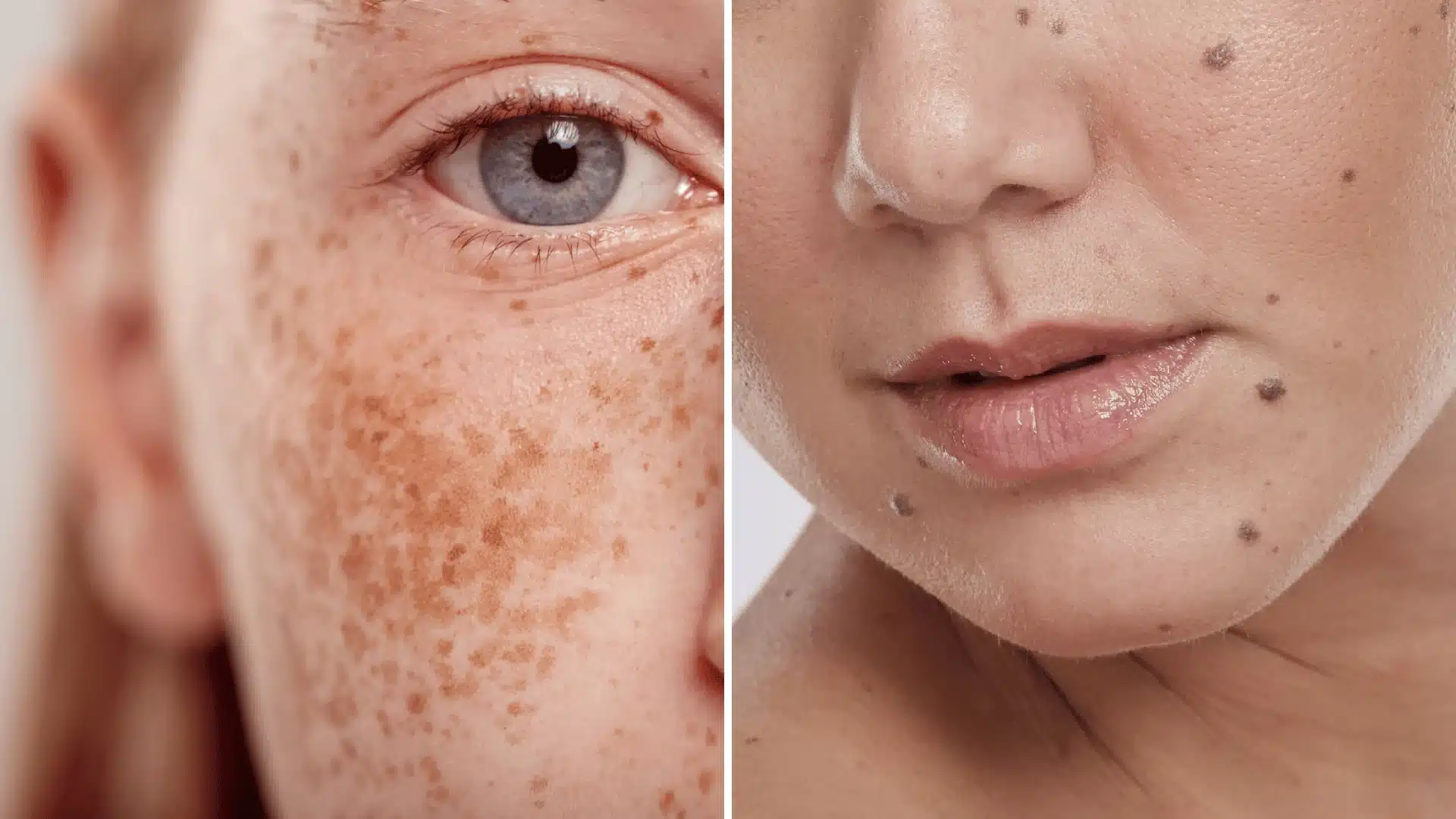
The confusion between freckles and moles is real, because both are small, brown, and usually painless. But a few reliable differences make it possible to tell them apart without a medical background.
1. Texture and Feel
Texture is one of the easiest ways to compare the two. Freckles are flat and feel the same as the surrounding skin.
A fingertip should not feel any bump, edge, or thickness over a classic freckle. Moles can also be flat, but many feel slightly raised, round, smooth, or dome-shaped.
Some moles may have hair growing from them. A spot with clear height or a different feel is more likely to be a mole than a freckle.
2. Color Range
Freckles usually stay within a narrow color range. Most are light tan, golden brown, or reddish brown. A single freckle usually looks evenly colored from edge to edge.
Moles can appear in more shades, including skin-toned, pink, light brown, dark brown, or almost black. Some moles may also show more than one shade.
A spot with uneven color, very dark areas, or sudden color change should be watched closely and checked by a dermatologist.
3. Seasonal Behavior
Freckles often change with sun exposure. They usually become darker in summer or after outdoor time because UV light increases melanin production.
In winter, or when sun exposure drops, classic freckles may fade and become less noticeable. Moles do not follow this same seasonal pattern.
A mole usually stays visible all year and keeps a more stable appearance. If a brown spot fades in winter, it is more likely to be a freckle. If it stays the same, it may be a mole.
4. Location Patterns
Freckles usually appear on areas that receive regular sun exposure. Common spots include the nose, cheeks, forehead, shoulders, upper arms, chest, and the backs of the hands.
They often show up in groups rather than as a single mark. Moles can appear almost anywhere on the body.
They may grow on the scalp, back, stomach, legs, underarms, soles, or even areas that rarely see sunlight. Location alone cannot confirm the answer, but it gives a useful clue.
Freckles vs Moles: Cancer Risk and When to Get Checked

Freckles themselves do not turn into melanoma because they are flat areas of extra pigment, not skin growths. Still, frequent freckling can mean the skin reacts strongly to UV exposure, so daily sunscreen is important.
Moles need closer attention because they are made of clustered melanocyte cells, and some types can change over time.
Higher-risk signs include a mole that becomes uneven, grows quickly, develops mixed colors, bleeds, itches, or looks different from the rest of your moles.
Large congenital moles, atypical moles, and having more than 50 moles can also raise melanoma risk.
If a flat mole concerns you, it may be worth reading about effective methods for flat mole removal to understand your options before a consultation.
Beauty Mark vs Freckle: What is the Difference?
A beauty mark is usually a mole, while a freckle is a flat, sun-related pigment that often changes with the season and sun exposure over time.
| Feature | Beauty Mark | Freckle |
|---|---|---|
| Skin type | A mole, not a separate skin category | A flat pigment spot in the outer skin layer |
| Cause | Clustered melanocyte cells in one area | Extra melanin is made after UV exposure |
| Texture | Can be flat, slightly raised, or dome-shaped | Flat and smooth like nearby skin |
| Color | Skin toned, pink, brown, dark brown, or black | Light tan, golden brown, or reddish brown |
| Seasonal change | Usually stays the same year-round | Often darkens in summer and fades in winter |
| Common location | Near the lip, cheek, eye, or other noticeable areas | Nose, cheeks, shoulders, arms, and hands |
| Monitoring need | Should be checked if it changes, bleeds, itches, or grows | Usually harmless, but sun protection still matters |
When to See a Dermatologist About a Mole
Most moles are stable and benign. The ones worth acting on are the ones that change. Dermatologists use the ABCDE framework to identify moles that warrant a closer look, and it is worth memorizing because it takes about thirty seconds to apply.
- Asymmetry: One half of the mole does not match the other. A normal mole looks roughly the same on both sides of an imaginary center line.
- Border: The edges are ragged, notched, or blurred rather than smooth and defined. Melanin spreading into surrounding skin is a concern.
- Color: Multiple shades within a single mole, or shades of white, grey, red, or blue alongside the usual brown, are worth reporting to a dermatologist.
- Diameter: Most benign moles are smaller than 6 millimeters, roughly the width of a pencil eraser. Larger is not automatically dangerous, but it raises the level of attention.
- Evolving: Any mole that changes in size, shape, color, or elevation over a period of weeks or months should be evaluated. This is the most important criterion on the list.
If a mole has already been removed and you are now tracking how the skin is healing, the mole removal healing stages guide walks through what to expect day by day.
How to Care for Freckled and Mole-Prone Skin
Healthy freckled or mole-prone skin depends on UV protection, gentle skin care, and regular checks for spots that change in size, color, or shape.
- Daily sunscreen: Use broad-spectrum SPF 30 or higher on exposed skin every morning. Reapply every two hours when outdoors, sweating, or swimming.
- Vitamin C serum: Apply vitamin C before sunscreen in the morning. It can support uneven tone, but it does not replace sun protection.
- Retinoids: Use a low-strength retinoid at night to support skin cell turnover and help fade sun-related pigmentation over time.
- UPF clothing: Wear wide-brim hats, sunglasses, long sleeves, or UPF-rated clothing during long outdoor exposure.
- Monthly skin checks: Check moles once a month for growth, bleeding, itching, uneven color, or shape changes.
Conclusion
Knowing the difference between freckles and moles makes daily skin care and monthly checks more practical. Freckles usually point to sun-related pigment, while moles deserve closer watching because they are skin growths that can change over time.
The most useful habit is not panic; it is noticing patterns. Check spots in good lighting, look for changes in size, shape, color, texture, itching, bleeding, or a mark that looks unlike the others.
Use sunscreen every day, cover up during strong sun, and book a dermatologist visit when a spot feels uncertain.
A quick check can bring peace of mind and catch problems early. Have a spot you are unsure about? Share your question in the comment section and start the conversation.
Frequently Asked Questions
Can Freckles Turn into Moles?
Freckles cannot turn into moles. They are structurally different: freckles are areas of increased melanin pigment in the outer skin layer, while moles are clusters of melanocyte cells within the skin.
Do Moles Go Away on Their Own?
Some moles do fade or disappear over time, particularly acquired moles in older adults. This is generally normal.
Is it Normal to Get New Freckles as an Adult?
Yes. New freckles can appear in adulthood, usually from cumulative sun exposure rather than the childhood sun sensitivity that causes most early freckles.