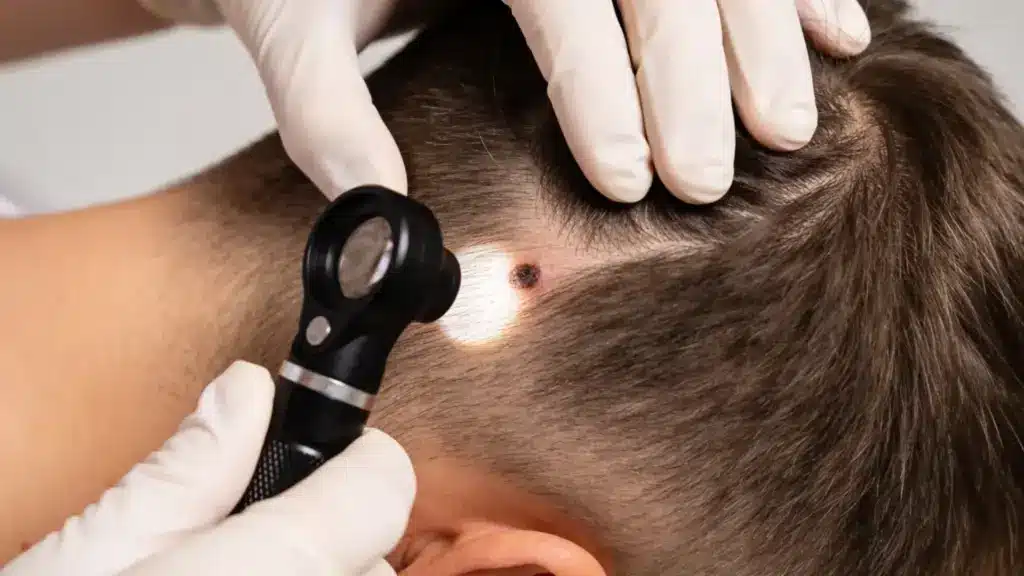
You are midway through a haircut when your stylist pauses and says, “Hey, have you noticed this spot on your scalp?” Your stomach drops.
Suddenly, a mole you never thought about becomes all you can think about. I have heard this from so many clients, and honestly, I have been there myself.
The scalp is one of those areas most people completely forget to check, partly because hair covers it and partly because we just do not think about it.
A mole on the scalp is more common than you might expect, and most of the time, it is nothing to stress about. But knowing what to look for, and when to act, makes all the difference.
What Exactly is a Mole on the Scalp?
A mole on the scalp works the same way as any other mole on your body. It forms when pigment-producing cells called melanocytes cluster together instead of spreading out evenly across the skin.
Think of it like a small group of cells deciding to stay close together in one spot. These clusters can appear anywhere skin exists, and your scalp absolutely qualifies.
A typical, harmless scalp mole is round or oval, has a smooth border, and is a uniform shade of brown. It stays consistent over time, does not itch or bleed, and is usually smaller than a pencil eraser, which is about 6mm across.
The tricky part is that your scalp moles are hidden beneath layers of hair, making it much harder to spot changes than on your arm or face.
In medical terms, moles are called nevi, but let us stick with what everyone knows.
Most adults have somewhere between 10 and 40 common moles across their bodies, according to the National Cancer Institute. The scalp is a less common spot for them, which is exactly why they often go unnoticed for so long.
Types of Scalp Moles You Should Know About
Not all scalp moles look or behave the same way. Knowing which type you have helps you understand what level of attention it deserves.
1. Flat moles: Sit right at skin level, usually brown or black in color, and feel smooth when you run a finger over them.
2. Raised moles: They have a bumpy texture and can sometimes catch on a comb or snag during vigorous hair washing.
3. Dysplastic (atypical): They are larger than average, with irregular edges and uneven color, and carry a slightly higher risk of becoming cancerous.
4. Congenital moles: They are present from birth. Roughly one in every 100 babies is born with at least one, according to the American Academy of Dermatology.
What Does Melanoma on the Scalp Look Like?

Scalp melanoma can appear in several different forms, which is why many cases are overlooked during the early stages.
While some lesions match the familiar image of a dark, irregular mole, others look far less suspicious. A common presentation includes a dark spot with uneven borders and multiple shades of brown, black, or blue.
In other cases, melanoma may develop as a pink or red, firm bump that resembles a persistent pimple, often associated with the aggressive nodular subtype. Some lesions appear pale or skin coloured, making them easy to dismiss as harmless skin changes.
Rough, wart-like growths or raised patches that suddenly appear can also signal abnormal skin activity. Another warning sign includes scaly areas, bleeding sores, or spots that crust and fail to heal over time.
Any existing mole that begins changing in size, shape, color, or sensation should never be ignored, especially on the scalp, where visibility is limited.
ABCDE Rule for Spotting Dangerous Moles
The ABCDE rule is the most widely used method for evaluating any mole, and it works just as well for a mole on the scalp as it does anywhere else on your body.
I always tell clients: learn this by heart, not because it will make you anxious, but because it helps you notice when something actually looks different.
- A for Asymmetry: Draw an imaginary line down the center of the mole. If the two halves do not match, that is a flag worth noting.
- B for Border: Healthy moles have smooth, well-defined edges. Ragged, blurred, or notched borders are worth watching.
- C for Color: One uniform shade is generally fine. Multiple colors within a single mole, such as mixtures of brown, black, red, or pink, require professional evaluation.
- D for Diameter: Anything larger than a pencil eraser (about 6mm) warrants attention, though some melanomas can be smaller.
- E for Evolving: This is the big one. Any mole that changes in size, shape, color, or texture over time should be shown to a dermatologist.
There is also an informal guide called the “ugly duckling” rule: if one mole looks noticeably different from all the others on your body, that outlier deserves a closer look, even if it does not check every ABCDE box.
Physical Symptoms Beyond Appearance
Scalp melanoma is not always identified solely by appearance. In some cases, physical symptoms develop before noticeable visual changes occur. Since the scalp is hidden beneath hair, unusual sensations or persistent irritation may be the first warning signs that something is wrong.
- Persistent itching or tenderness in one area of the scalp
- Tingling or numbness around a mole
- Bleeding from a mole without scratching or injury
- A sore that repeatedly heals and reopens
- Pain or inflammation around an existing mole
- Swollen lymph nodes in the neck
Why the Scalp is a Particularly High-Risk Site
The scalp is constantly exposed to the sun, yet many people forget to protect it with sunscreen or a hat, allowing UV damage to build gradually over time.
Melanoma on the scalp can also be more dangerous because hair hides suspicious spots, delaying detection until the lesion has already progressed.
The scalp contains a dense network of blood vessels and lymph nodes, which may allow cancer cells to spread faster than melanomas found on other body areas.
Although melanoma can affect anyone, certain factors significantly increase the risk of developing concerning scalp moles.
- Chronic UV exposure and repeated sunburns
- Fair skin, light hair, or a family history of melanoma
- Age over 50, male sex, or having many body moles
- Tanning bed use or a weakened immune system
Tips to Protect Your Scalp from Sun Damage and Mole Changes

The scalp is often overlooked in daily sun protection, even though it receives direct UV exposure during outdoor activities. Consistent protection can help reduce long-term skin damage and lower the risk of suspicious changes in moles.
- Wear protective accessories: Wear a wide-brimmed hat or a UV protective cap when spending long periods outdoors, especially during peak sunlight hours between 10 AM and 4 PM.
- Apply sunscreen to exposed areas: Apply a broad-spectrum SPF 30 or higher sunscreen directly to the scalp, including thinning spots and visible part lines.
- Use scalp sunscreen sprays when needed: If you have thicker hair, choose a spray that applies easily through hair without leaving a greasy texture.
- Reapply regularly: Reapply sunscreen every two hours when outdoors, particularly after sweating or swimming.
Treatment Options for a Mole on the Scalp
If a dermatologist decides that a scalp mole should be removed, the recommended treatment usually depends on the mole’s size, location, appearance, and whether cancer is suspected.
Most scalp mole removal treatments are completed during a single outpatient visit and generally involve minimal recovery time.
| Treatment Option | Description | Common Use |
|---|---|---|
| Surgical excision | Removes the mole along with a small margin of surrounding skin for complete removal | Suspicious or potentially cancerous moles |
| Mohs surgery | Skin is removed layer by layer and examined under a microscope until no abnormal cells remain | Confirmed melanoma or high-risk lesions |
| Shave removal | The mole is shaved level with the surrounding skin surface | Small raised non-cancerous moles |
| Laser removal | Uses targeted laser energy to remove pigment from the mole | Small flat benign moles |
Note: Scalp moles should be examined by a dermatologist before removal, especially if the mole changes in size, shape, color, or starts bleeding or itching. Procedures like laser removal are not usually recommended for suspicious moles because they can make accurate cancer evaluation more difficult after treatment.
When to See a Professional for a Mole on the Scalp?
A professional skin check is especially important if the mole looks different from your other moles, follows any ABCDE warning signs, or appears recently and keeps changing.
The American Cancer Society and CDC both recommend getting new, changing, or unusual spots checked by a doctor.
Because scalp moles are hard to monitor on your own, ask your barber, hairstylist, partner, or dermatologist to help check the area regularly. Early evaluation is always safer than waiting and guessing.
See a dermatologist if a mole on your scalp starts changing in size, shape, color, height, or texture. You should also book an appointment if the spot bleeds, crusts, itches, hurts, scabs, or does not heal.
Conclusion
A mole on the scalp is easy to ignore because it stays hidden beneath the hair for years without drawing attention.
That hidden location is exactly what makes regular scalp checks so important. Even small changes in texture, sensation, or color deserve attention when they persist over time.
Early evaluation can prevent unnecessary complications and give dermatologists the best chance to treat suspicious lesions before they become more serious.
Building simple habits such as checking your scalp monthly, using sun protection, and monitoring unusual spots can make a meaningful difference in long-term skin health. Paying attention now is always easier than dealing with advanced skin damage later.
If a scalp mole looks unusual or feels different, schedule a professional skin examination as soon as possible.
Have you ever found a mole or unusual spot on your scalp? Share your experience in the comments, and let others know what helped you notice it early.
Frequently Asked Questions
Can Dandruff Hide Scalp Melanoma Symptoms?
Yes, flaking, itching, and irritation from scalp melanoma may sometimes resemble dandruff, causing delayed diagnosis.
Should a Barber or Hairstylist Mention Suspicious Scalp Moles?
Many dermatologists encourage barbers and hairstylists to point out unusual scalp spots because they often notice areas that clients cannot easily see themselves.
Can Hair Grow Through a Melanoma on The Scalp?
Yes, hair can still grow through a melanoma lesion, which is why the presence of hair does not automatically mean a scalp mole is harmless.