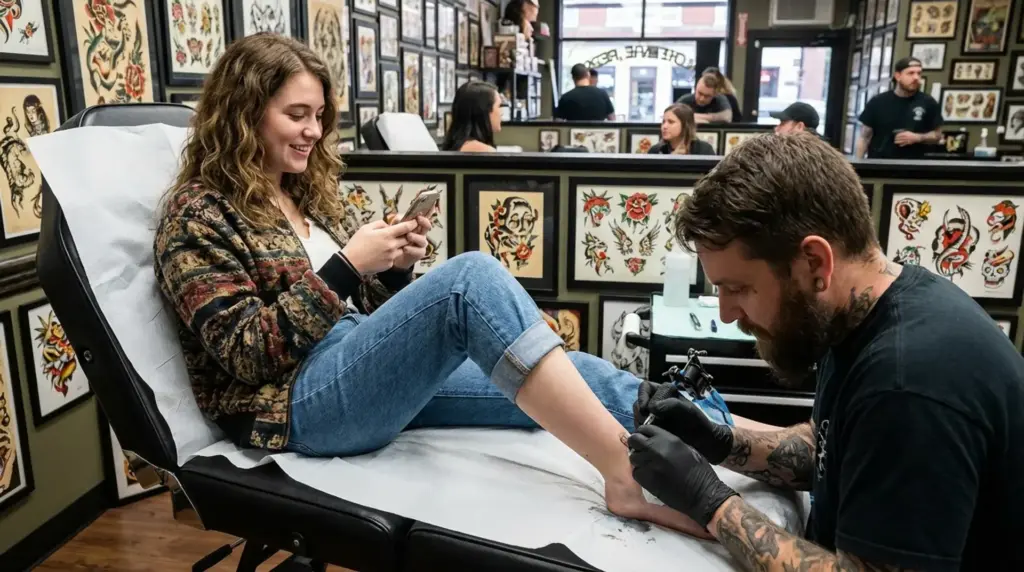
A late-night scroll through tattoo reels, saved design boards, and group chats full of “should I get this?” messages can quickly turn a simple idea into a real plan.
The excitement builds fast. The design feels perfect. The appointment link is right there. Then one question suddenly stops everything. Are you actually old enough to get a tattoo?
Many people assume tattoo rules are the same everywhere, but that is rarely the case.
Regulations vary by location, and the rules about getting inked without parental permission can co12nfuse even the most prepared first-timers.
Before scheduling an appointment or walking into a studio, understanding the legal side of tattoos matters more than most people expect.
This blog breaks down the age requirements, permission requirements, and the situations people often face when getting their first tattoo.
How Old Do You Need to be to Get a Tattoo
In many places, the legal age to get a tattoo without parental permission is 18.
In the United States specifically, all states and the District of Columbia have laws requiring a person to be at least 18 years old to receive a tattoo without any parental consent.
There is no federal law governing tattooing, so each state sets and enforces its own regulations.
The 18-year minimum is rooted in a foundational legal principle: minors cannot enter into a legal contract or provide informed consent for a procedure.
This is the same reasoning that underpins age requirements in medical and legal settings, and it applies directly to tattooing across all US jurisdictions, as confirmed by Wikipedia’s documented legal status of tattooing in the United States.
Before any appointment begins, artists typically ask for a valid government-issued identification to confirm that the client meets the legal age requirement.
If someone cannot provide proof of age, the studio will usually refuse the service. These rules exist to protect both the client and the tattoo artist.
Tattoos are permanent and involve needles entering the skin, which makes safety, hygiene, and informed decision-making extremely important.
Age requirements help ensure that individuals fully understand the long-term commitment before getting inked.
At What Age Can You Get a Tattoo with Parental Consent
In some places, minors may be allowed to get a tattoo with a parent or legal guardian’s permission. This permission must usually be provided directly at the tattoo studio and cannot be a mere verbal agreement.
Tattoo artists and studio owners follow strict rules before accepting any request involving someone under the legal age.
Some states, including California, Alaska, New York, and several others, prohibit tattooing minors entirely, meaning no parental consent can override the minimum age of 18.
Alaska, contrary to what is sometimes stated, does permit tattooing of minors with written parental consent and the physical presence of a parent or guardian at the studio. Other states allow exceptions at lower ages.
Kansas, for example, permits tattooing for minors aged 16 and older with notarized written parental consent and a parent present during the session.
New Jersey allows minors as young as 16 with parental consent, and Idaho permits tattooing for minors as young as 14 with a consenting parent or guardian present.
The following states and territories prohibit tattooing of minors entirely, regardless of parental consent: California, New York, Arkansas, Maine, Mississippi, Rhode Island, North Carolina, South Carolina, and the District of Columbia. In these jurisdictions, the minimum age of 18 is an absolute requirement with no exceptions outside of medical necessity.
Emancipated minors represent a separate legal situation. While emancipation grants certain adult rights, tattoo laws in most states still require the individual to meet the state’s minimum age.
In states where the cutoff is strictly 18, emancipated status does not automatically allow a minor to get a tattoo.
Even when consent is allowed, many professional tattoo artists remain cautious and may decline requests if they feel the client is not ready for permanent body art.
Most reputable artists will not tattoo anyone under 15, even in states where it is technically legal with parental consent.
The reasoning is straightforward: the permanence of tattooing, the ongoing aftercare commitment, and the reality that the body is still growing all make very young clients high-risk for long-term regret and physical distortion of the design.
US Tattoo Age Laws: State Categories at a Glance
Laws vary significantly by state. This table provides a general overview of how states typically categorize their requirements. Always verify directly with your state’s health department or a licensed studio before making any plans, as laws can be updated.
| Category | States / Notes |
|---|---|
| 18 strictly required, no exceptions for minors | California, New York, Arkansas, Maine, Mississippi, Rhode Island, North Carolina, South Carolina, DC |
| 16+ with written parental consent and parent present | Kansas, New Jersey, Colorado, Florida (16-17), Arkansas (for cover-up only in some cases) |
| Under 16 with parental consent and presence (specific states) | Idaho (14+), Alabama (no specified minimum with parental written consent) |
| Minor consent allowed, specific age not codified | Arizona, Connecticut, Delaware and others — parental written and/or notarized consent required |
| Emancipated minor exceptions | Connecticut recognizes emancipated minor status; most states with strict 18 minimums (CA, NY, DC) do not |
Note: This table reflects general patterns based on publicly available legal guides as of early 2026. State laws are subject to change. Always confirm with your specific state’s regulations before proceeding.
Why Tattoo Age Restrictions Exist
Tattoo age restrictions exist for several important reasons, focusing on safety, responsibility, and long-term decision-making.
A tattoo is permanent body art, so laws are designed to ensure that people fully understand the commitment before getting one.
Health and safety are one major factor. Tattooing involves needles entering the skin, which carries risks if proper hygiene and professional practices are not followed.
Regulations help ensure that licensed studios follow strict sanitation standards to protect clients.
Maturity is another consideration. Younger individuals may change their preferences over time, and a design that feels meaningful today may not feel the same later.
The body continues to grow through adolescence, and tattoos placed on areas that stretch significantly during growth can become distorted or misshapen over time.
A design that looks clean and proportional at 15 may look quite different by adulthood.
Research supports the caution. According to data cited by the National Institute of Health, approximately 46% of adults report regretting tattoos they received before the age of 20. Among those, three out of four spent fewer than a few weeks planning the decision before getting inked. This is not a trivial figure, and it reinforces why age minimums exist as a protective measure rather than an arbitrary barrier.
Age limits encourage people to think carefully before making a permanent choice. These rules also protect tattoo artists and studios.
By following legal age requirements and consent procedures, professionals reduce the risk of legal problems and maintain responsible practices within the industry.
What Tattoo Shops Usually Require Before Tattooing
Professional tattoo studios follow clear procedures before starting any tattoo session. These steps help confirm that clients meet legal requirements and that the process follows proper safety standards.
- Valid Government ID: Most studios require a government-issued ID, such as a driver’s license, passport, or state ID. This confirms the identity and age of the client.
- Age Verification Before the Appointment: Tattoo artists usually check identification before the session begins. If the client cannot prove the required age, the studio will refuse the service.
- Consent Forms if Required: Clients are often asked to sign consent forms. These documents confirm that the person understands the procedure and agrees to the tattoo.
- Parent or Guardian Presence for Minors: When tattoos for minors are allowed, a parent or legal guardian must usually be present at the studio to provide permission.
- Health and Safety Documentation: Many studios require basic forms about medical conditions or skin sensitivities. This helps the artist take proper precautions during the tattoo process.
What Happens if Someone Gets a Tattoo Underage

Getting a tattoo before meeting the legal age requirement can lead to several consequences for both the individual and the tattoo studio.
Laws regarding tattooing are taken seriously, and violations can result in legal and health consequences.
For tattoo studios and artists, tattooing a minor without proper consent can result in penalties. These may include fines, license suspension, or even permanent closure of the studio.
Because of this, reputable tattoo artists carefully verify a client’s age before beginning any procedure.
In some cases, parents or guardians may file complaints against the studio or the person who performed the tattoo.
Health risks are another major concern. Underage tattoos are sometimes done in unregulated settings where hygiene and safety practices may not meet professional standards.
This increases the risk of infections, skin damage, allergic reactions, and poorly executed tattoos that may require costly removal later.
Things to Think About Before Getting Your First Tattoo
Getting a first tattoo is exciting, but it is also a permanent decision that deserves careful thought. Taking time to plan can help avoid regret later.
- Choose A Design that Will Still Feel Meaningful Years Later: Trends change quickly, so selecting a design with personal meaning can help ensure the tattoo still feels right in the future.
- Research Professional Tattoo Artists and Studios: Look for licensed studios with strong hygiene standards and experienced artists. Checking reviews and past work can help identify reliable professionals.
- Understand Tattoo Aftercare: Proper aftercare is essential for healing. Following the artist’s instructions helps prevent infection and protects the quality of the tattoo.
- Think About Placement and Visibility: Consider how visible the tattoo will be in daily life, especially in professional settings or formal environments.
- Consider Long-Term Commitment: Tattoos are permanent. Carefully considering the design, size, and placement helps ensure the decision remains satisfying over time.
- Consider Career and Professional Implications: Certain professions, including military service, law enforcement, healthcare, aviation, and some corporate environments, have policies around visible tattoos. Placement on the hands, neck, or face carries more professional risk than placement on covered areas. This is worth thinking through before choosing a location, especially for a first tattoo.
- Factor in the Real Cost: A tattoo involves more than the artist’s fee. Quality aftercare products, potential touch-up sessions, and the long-term cost of sun protection all add up. Budgeting for the full experience rather than just the appointment helps avoid cutting corners on care.
Reddit: Huge Tattoo at 15 Sparks Online Debate
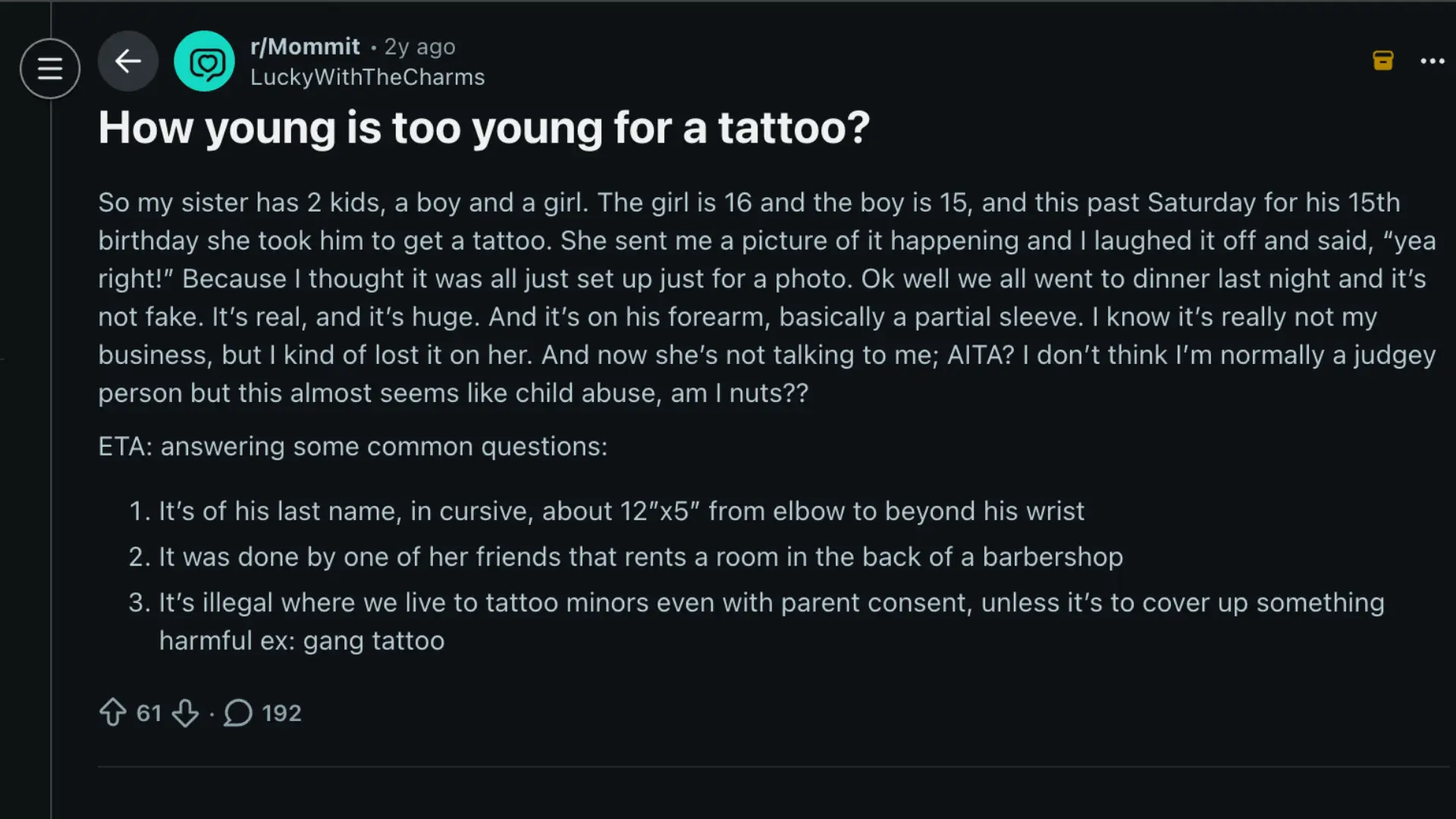
A Reddit user shared a story about their nephew receiving a large forearm tattoo for his 15th birthday.
The tattoo, showing his last name in cursive, stretched from the elbow past the wrist and was reportedly done by a friend who works in a room behind a barbershop.
The situation upset the poster, especially because tattooing minors is illegal where they live. When the poster confronted their sister during dinner, it created tension in the family.
Many commenters agreed that tattooing someone that young raises serious concerns, particularly when the artist ignores legal rules and safety standards.
Others argued it was ultimately the parents decision, even if it was controversial.
Conclusion
Getting a tattoo is more than picking a design that looks cool in the moment. It also involves understanding the rules, responsibilities, and long-term impact of permanent body art.
As explained in this guide, the answer to how old do you need to be to get a tattoo depends on local regulations and studio policies.
Since tattoo laws can vary from place to place, checking the requirements in your area before booking an appointment is always a smart step.
It helps avoid legal issues and ensures the tattoo is done safely by a professional studio.
Taking time to think about the design, placement, and long-term meaning can also make the experience far more satisfying.
At what age do you think is right for a first tattoo? Share your thoughts in the comments.
Frequently Asked Questions
Can Tattoo Shops Refuse Service Even If You Meet The Age Requirement?
Yes, tattoo studios can refuse service at their discretion. Artists may decline a request if the client appears unsure about the design, the placement is risky, or studio policies are not met.
Do All Tattoo Studios Follow the Same Age Policies?
No, policies can vary depending on local laws and studio rules. Some studios may set stricter requirements than the minimum legal age to maintain safety and professionalism.
Can a Tattoo Be Removed if Someone Regrets Getting It Young?
Yes, tattoo removal is possible through procedures such as laser treatment. However, removal can take multiple sessions, may be expensive, and can be more uncomfortable than getting the tattoo itself.
Which States Prohibit Tattooing Minors Entirely?
States that prohibit tattooing minors regardless of parental consent include California, New York, Arkansas, Maine, Mississippi, Rhode Island, North Carolina, South Carolina, and the District of Columbia. In these locations, no parental permission can override the strict 18-year minimum. Always verify with your state’s current regulations as laws can change.
Does Being an Emancipated Minor Allow You to Get a Tattoo?
Not automatically. In most states with a strict 18-year minimum, including California and New York, emancipated status does not override the age requirement for tattooing. Some states, such as Connecticut, do recognize emancipated minor status for tattoo consent purposes. The safest approach is to check the specific statute in your state rather than assuming emancipation grants this right.
What Documentation Is Required for a Minor to Get a Tattoo with Parental Consent?
Requirements vary by state, but most commonly include: a valid government-issued ID for both the minor and the parent or guardian, a written consent form signed by the parent, and in some states such as Kansas and Delaware, a notarized consent document. The parent or guardian is typically required to be physically present at the studio at the time of the tattoo, not simply to have signed paperwork in advance.